
Zysora Magazine
Why Small Businesses Are Switching From IVR to AI Voice Agents in 2026
You've called a business before and heard it.
"Press 1 for sales. Press 2 for support. Press 3 for billing. Press 4 to repeat these options."
You waited.
You pressed a number.
You got transferred to the wrong department.
You waited again.
Maybe you hung up.
That experience is frustrating, impersonal, and completely unhelpful.
This is what millions of customers go through every single day when they call a business that's still running an IVR system.
And for a long time, small businesses felt like they had no alternative.
IVR was the "professional" option.
It was what you set up when you wanted your business to sound established and organised.
But in 2026, that's changed completely.
Small businesses across every industry are quietly making a switch from rigid, menu-driven IVR systems to intelligent, conversational AI voice agents.
And once they make the switch, very few go back.
In this article, we're going to break down exactly what IVR is, why it's failing small businesses, what AI voice agents do differently, and why 2026 is the year this shift is accelerating faster than ever before.
What Is IVR and How Did We Get Here?
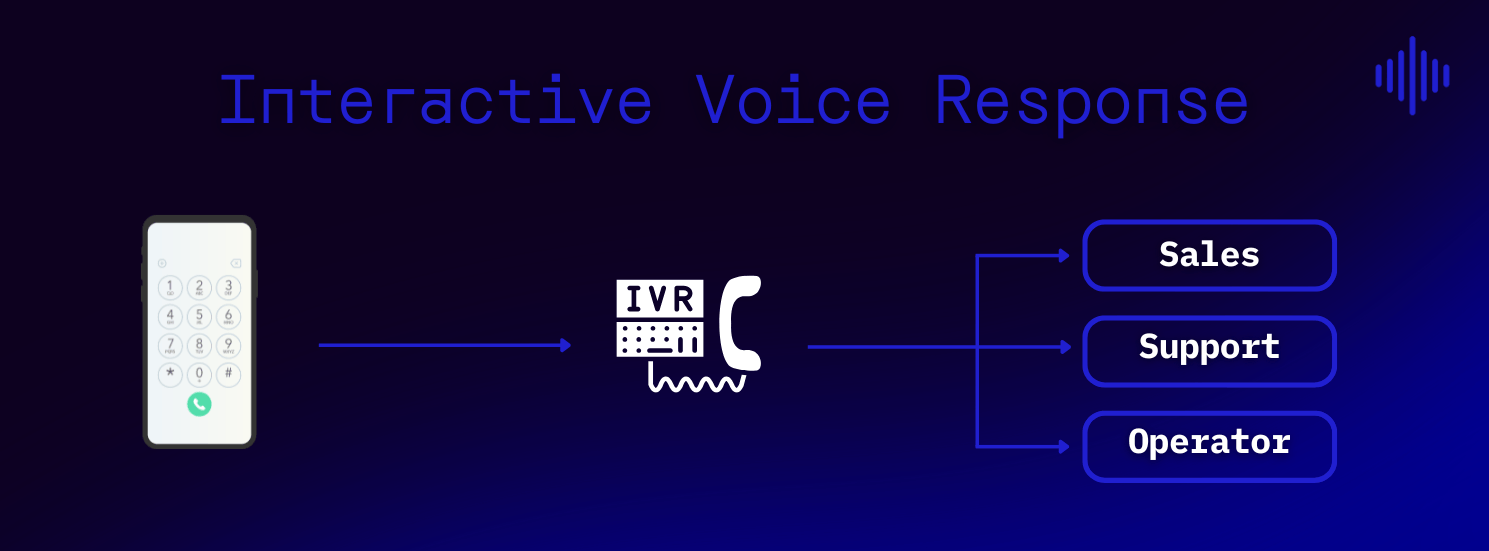
IVR stands for Interactive Voice Response.
It's the automated phone system that greets callers with a pre-recorded message and directs them through a menu of numbered options.
You press 1, you go to sales. You press 2, you go to support. And so on.
IVR technology was introduced in the 1970s and became widely adopted by businesses throughout the 1980s and 1990s.
At the time, it was genuinely impressive.
For the first time, businesses could handle large call volumes without putting every single caller on hold waiting for a human agent.
It was scalable, consistent, and relatively affordable.
For large enterprises with thousands of daily calls and complex internal routing needs, IVR served a real purpose.
It helped sort callers into the right queues and reduced the burden on human agents for very basic tasks.
But somewhere along the way, it got applied to small businesses too. And that's where the problems started.
Small businesses don't have the same call volumes or departmental complexity as large enterprises.
What they need isn't a menu system — they need a smart, responsive assistant that can actually help their customers.
IVR was never designed for that. And in 2026, customers know the difference.
The Problem With IVR for Small Businesses
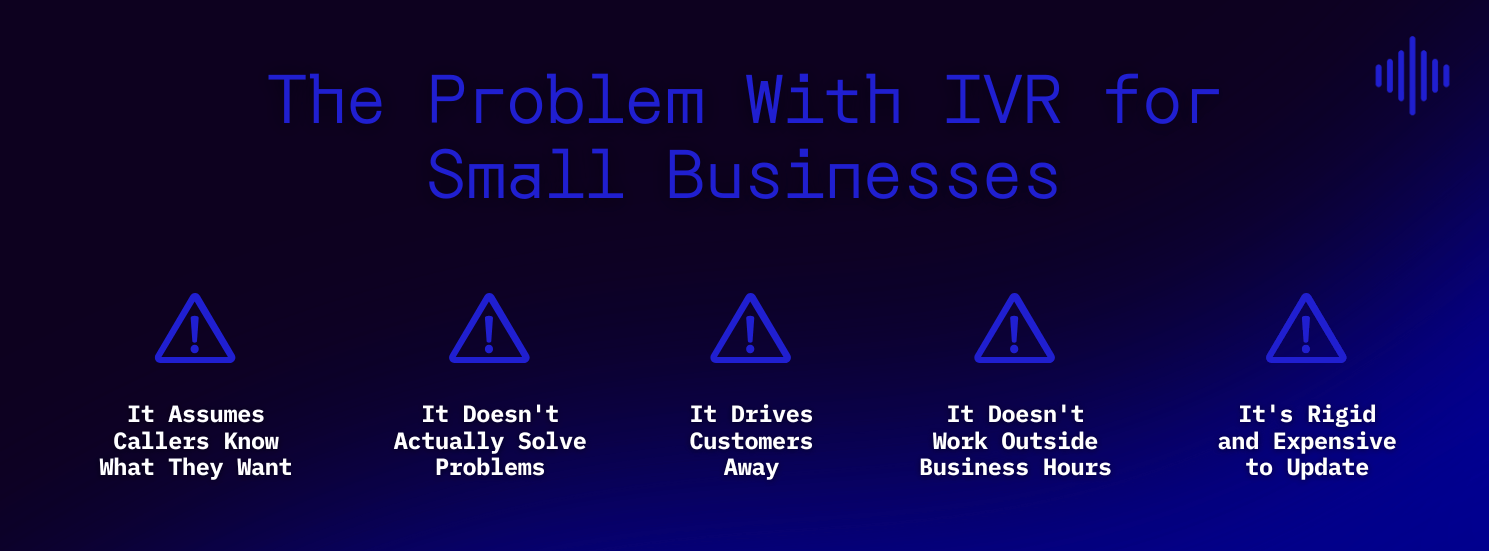
Let's be specific about why IVR falls short for small businesses.
This isn't about IVR being a bad technology in an absolute sense, it's about it being the wrong tool for what small businesses actually need.
It Assumes Callers Know What They Want
IVR menus are built around a fixed set of options that the business has pre-determined. Press 1 for this. Press 2 for that. But real customers don't always fit neatly into those categories. They call because they have a question, a problem, or a need — and that need doesn't always map cleanly to a numbered menu.
When a caller can't figure out which option applies to them, they do one of two things: they press a random number and hope for the best, or they hang up. Either outcome is bad for your business.
It Doesn't Actually Solve Problems
IVR is a routing system, not a problem-solving system. All it can do is move callers from one place to another. It can't answer a question, book an appointment, collect information, or provide any real value to the person calling. It's a middleman that adds steps without adding help.
For small businesses where customers are often calling with simple, specific questions.
"What are your hours?"
"How much does this cost?"
"Can I book an appointment for Thursday?"
IVR forces them through a menu just to eventually reach a human who could have answered in ten seconds. That's a frustrating experience that reflects poorly on your brand.
It Drives Customers Away
The data on customer attitudes toward IVR is pretty damning. Studies consistently show that the majority of callers have a negative reaction to IVR systems. A significant portion hang up immediately upon hearing the automated menu. Many report that IVR makes them feel undervalued as a customer.
In a world where customer experience is one of the primary differentiators between businesses, that reaction is a serious problem. Every time a customer hangs up on your IVR, you've created a negative association with your brand and potentially sent them straight to a competitor who answers with a real voice.
It Doesn't Work Outside Business Hours
Most small business IVR systems are tied to their office phone lines. Outside of business hours, callers either hit a dead end or get sent to voicemail. As we covered in a previous article, the majority of callers who reach voicemail don't leave a message — they just move on.
This means IVR does nothing to solve the after-hours problem that costs small businesses so much revenue.
It's Rigid and Expensive to Update
When your services change, your prices change, or your team structure changes, updating an IVR system is often a complicated, time-consuming process. You need to re-record audio prompts, restructure menu trees, and potentially work with your phone provider to make changes. For a small business that moves quickly and evolves often, that rigidity is a real operational burden.
What AI Voice Agents Do Differently
AI voice agents aren't just an upgraded version of IVR. They're an entirely different category of technology that approaches phone communication from a completely different direction.
Where IVR is rigid, AI voice agents are flexible. Where IVR routes, AI voice agents resolve. Where IVR frustrates, AI voice agents help.
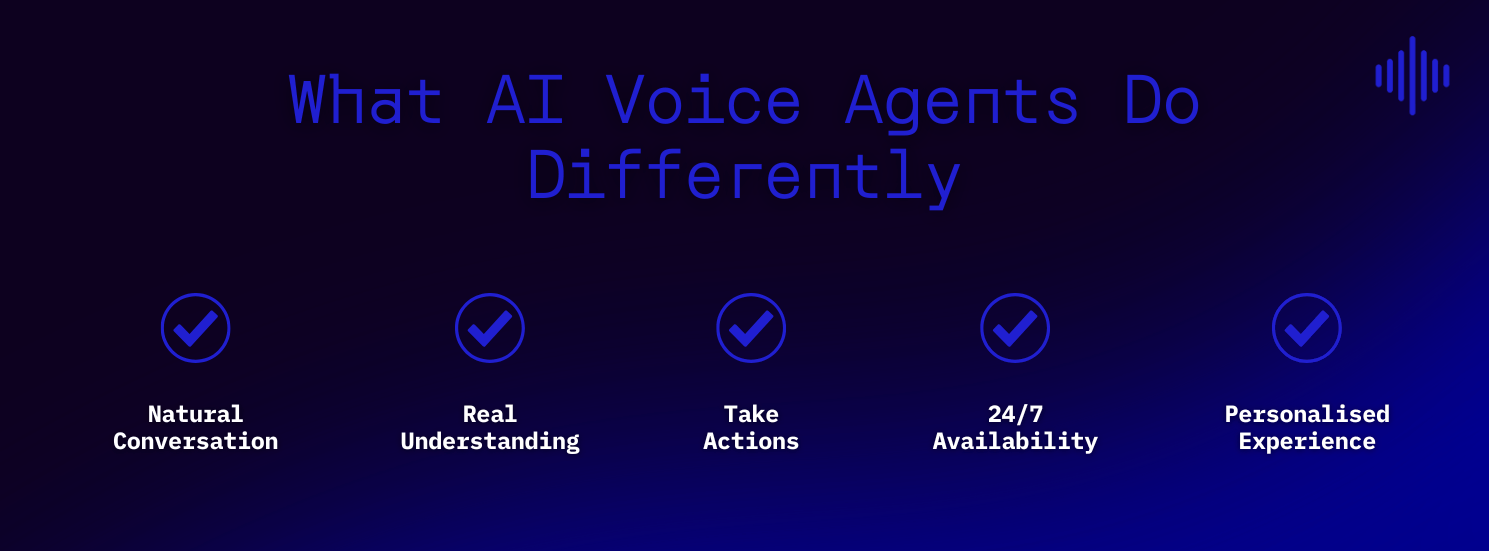
Here's a breakdown of the core differences:
Natural Conversation vs. Numbered Menus
The most fundamental difference is how the interaction works. IVR forces callers into a predetermined structure. They can only do what the menu allows. AI voice agents engage in open, natural conversation. A caller can say anything, ask anything, phrase their question any way they like and the agent understands and responds appropriately.
Instead of "Press 1 for appointments", a caller can just say "I'd like to book an appointment for next Friday afternoon" and the AI voice agent handles it from there.
No menus. No button pressing. Just a conversation.
Real Understanding vs. Button Presses
IVR doesn't understand language. It only recognises which button was pressed. If the caller presses the wrong button, the system has no way of knowing or correcting course.
AI voice agents use advanced natural language processing and large language models to actually understand what a caller is saying, including the intent behind their words.
If a caller says "I need to move my appointment", the agent understands that this is a rescheduling request, not a cancellation and not a new booking. It responds accordingly, just like a human would.
Action vs. Routing
IVR can only direct callers. It cannot take action on their behalf. AI voice agents can actually do things like book appointments, answer specific questions from a knowledge base, collect lead information, log details in a CRM, send confirmation messages, and transfer calls to the right person when needed.
This is the difference between a system that moves people around and a system that actually serves them.
24/7 Availability vs. Business Hours Only
AI voice agents are available around the clock, every day of the year. They don't have shifts, they don't take holidays, and they don't have an end-of-day handover. Every call that comes in at any time gets answered with the same quality of response.
This alone is a game-changer for small businesses that currently lose significant revenue to after-hours calls.
Continuous Improvement vs. Static Menus
IVR systems stay exactly as they are until someone manually changes them. AI voice agents can be updated quickly and easily as your business evolves. New services added, prices updated, conversation flows refined based on real call data. They get better over time, not worse.
Personalised Experience vs. Generic Responses
AI voice agents can be trained to sound like your brand using your terminology, your tone, and your way of communicating with customers. A good AI voice agent doesn't sound like a generic automated system. It sounds like a knowledgeable, friendly representative of your specific business.
Why 2026 Is the Tipping Point
The shift from IVR to AI voice agents didn't happen overnight. The technology has been developing for years. But 2026 is the year this transition is accelerating rapidly for small businesses specifically, and there are clear reasons why.
The Technology Has Matured
Early AI voice technology was imperfect. There were issues with understanding accents, handling interruptions, and managing complex conversations. Those issues have largely been resolved. In 2026, AI voice agents can handle real, unscripted conversations with a level of naturalness and accuracy that wasn't possible just a few years ago. The quality gap between AI and human conversation has narrowed dramatically.
It's Now Affordable for Small Businesses
For a long time, sophisticated AI voice technology was only accessible to large enterprises with significant technology budgets. That's no longer the case. The cost of building and deploying a custom AI voice agent has dropped substantially, making it a viable investment for small and medium businesses that couldn't have considered it before.
Customer Expectations Have Shifted
Customers in 2026 have higher expectations than ever. They've experienced the convenience of instant, intelligent responses in other areas of their lives from smart assistants on their phones to AI-powered customer service in major apps. They now expect the same level of responsiveness from every business they interact with. An IVR menu feels increasingly outdated and off-putting by comparison.
Small Businesses Are Falling Behind on Calls
The awareness of the missed call problem has grown significantly. More small business owners understand that unanswered calls are costing them real money and they're actively looking for solutions. AI voice agents are the most complete solution available, and word is spreading fast.
Competition Is Driving Urgency
As some small businesses adopt AI voice agents and start capturing more leads, answering more calls, and converting more customers, their competitors feel the gap widening. The businesses that move early gain a compounding advantage that becomes harder to close over time. This competitive pressure is pushing more and more small businesses to act now rather than wait.
Industries Leading the Switch
While AI voice agents are relevant for any business that relies on phone communication, certain industries are leading the adoption in 2026.
Medical and Dental Clinics
Medical and Dental Clinics are among the earliest adopters. Appointment scheduling is one of the most common and time-consuming call types for healthcare practices, and AI voice agents handle it seamlessly with booking, confirming, and rescheduling appointments without any staff involvement.
Real Estate Agencies
Real Estate Agencies are using AI voice agents to handle enquiries on listings, qualify leads based on budget and requirements, and book viewings directly into agents' calendars. In an industry where response time directly impacts conversion, being reachable 24/7 is a massive competitive advantage.
Law Firms and Legal Advisors
Law Firms and Legal Advisors are implementing AI voice agents to handle initial enquiries, collect case details, and schedule consultations, all while maintaining a professional tone that reflects the seriousness of the industry.
Home Service Businesses
Plumbers, electricians, HVAC companies, cleaners are seeing major benefits from AI voice agents that can handle emergency and after-hours calls, quote standard service fees, and book jobs on the spot.
Salons and Spas
Salons and Spas are using AI voice agents to manage their booking lines entirely, freeing up staff to focus on delivering services rather than constantly answering the phone.
Coaching and Consulting Practices
Coaching and Consulting Practices rely heavily on discovery call bookings, and AI voice agents handle the entire process of answering initial enquiries and scheduling those calls automatically.
What these industries have in common is a heavy reliance on phone-based communication and appointment scheduling, exactly where AI voice agents deliver the most immediate and measurable impact.
A Real-World Scenario: IVR vs. AI Voice Agent
Let's make this concrete with a side-by-side scenario. Imagine a dental clinic receives a call at 7:30 PM on a Thursday evening.
With IVR:
The caller hears: "Thank you for calling City Dental. Our office is currently closed. Our hours are Monday to Friday, 9 AM to 5 PM. Please call back during business hours or press 1 to leave a voicemail."
The caller hangs up without leaving a voicemail. They search for another dentist. They book with a practice that has online booking available. City Dental never knows the call happened.
With an AI Voice Agent:
The caller hears: "Hi, thanks for calling City Dental! I'm the clinic's virtual assistant — I can help you with appointments, questions, or anything else you need. What can I do for you tonight?"
The caller says they need to book a cleaning appointment. The agent checks availability, offers three options for the following week, confirms the caller's preferred time, collects their details, and sends a confirmation. The call ends with a booked appointment.
Same scenario. Completely different outcome. One costs the clinic a patient. The other books one.
Common Concerns About Making the Switch
If you're a small business owner considering this transition, you might have some reservations. Here are the most common ones and the honest answers.
"Will it sound robotic and put my customers off?"
Modern AI voice agents don't sound like the robotic automated systems of the past. With the right setup and training, they sound natural, warm, and conversational. Most callers don't realise they're speaking with an AI and for those who do, the quality of service quickly becomes more important than the nature of who's providing it.
"What if it can't handle a complex call?"
AI voice agents are designed with a clear escalation path. When a call involves something beyond the agent's capabilities — an upset customer, an unusual request, or a complex situation — it transfers the call to a human team member smoothly and professionally. The agent handles what it can and knows when to hand over.
"Is it difficult to set up?"
With the right agency partner, the setup process is straightforward and fast. Most businesses are up and running within days. The agency handles the technical work. You just need to provide information about your business so the agent can be trained properly.
"What if my business information changes?"
Updates to your AI voice agent can be made quickly and easily. Unlike IVR, which requires re-recording audio files and restructuring menus, updating an AI voice agent is as simple as changing the information it's been trained on. Your agent evolves as your business does.
"Is it expensive?"
This is perhaps the most common concern, and the answer might surprise you. A custom AI voice agent from a specialist agency like Zysora is significantly more affordable than hiring a full-time receptionist and it provides capabilities that a human receptionist can't match, like 24/7 availability and handling multiple calls simultaneously.
How to Make the Switch: What the Process Looks Like
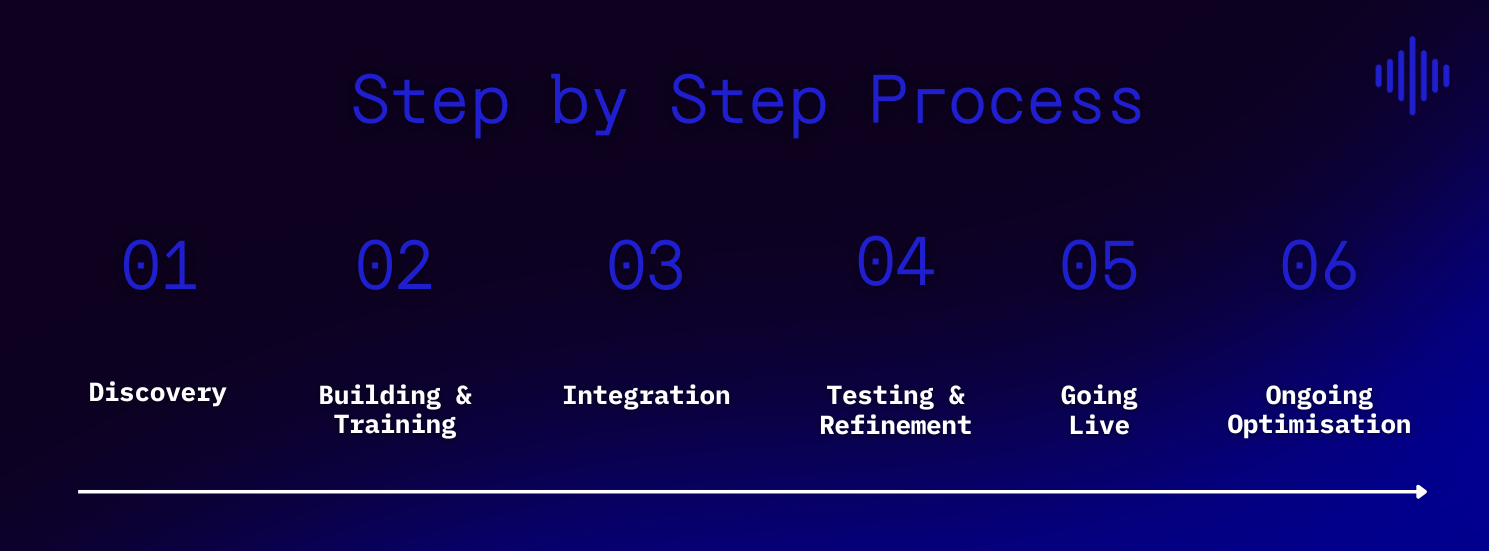
Transitioning from IVR to an AI voice agent doesn't have to be complicated. Here's what the process typically looks like when you work with Zysora:
Step 1 — Discovery
We start with a conversation about your business.
What calls do you currently receive?
What questions do customers typically ask?
What actions do you want the agent to be able to take?
What's your brand voice?
This information forms the foundation of your custom agent.
Step 2 — Building and Training
We build your AI voice agent from scratch, training it on your specific business information, conversation flows, and integration requirements. This isn't a generic template, it's a custom solution built around how your business actually works.
Step 3 — Integration
We connect your agent to your calendar, CRM, and any other tools it needs to take action on behalf of your business. Appointment booking, lead logging, call transfers, all set up and tested before launch.
Step 4 — Testing and Refinement
Before going live, we run the agent through a wide range of call scenarios to make sure it handles everything the way you want. We refine and adjust based on the results until the agent performs exactly as expected.
Step 5 — Going Live
Your agent goes live on your phone line. From this point, every call your business receives gets answered intelligently, 24 hours a day, 7 days a week.
Step 6 — Ongoing Optimisation
We monitor performance and make ongoing updates as needed. As your business grows and evolves, your AI voice agent grows with it.
The Competitive Reality of Waiting
Here's something worth sitting with for a moment. Every month that you keep running an IVR system — or worse, no system at all — is a month your competitors have the opportunity to pull ahead.
The businesses that are adopting AI voice agents right now are capturing leads that would otherwise be lost to missed calls. They're booking appointments at 11 PM when their competitors' phones go to voicemail.
They're delivering a better first impression with every single caller. And they're doing it all at a cost that makes the ROI straightforward.
The technology is available. The price point works for small businesses. The customer expectations are already there. The only thing standing between your business and all of that is the decision to act.
IVR had its moment. That moment has passed. The businesses that recognise this early and make the switch will look back on this as one of the best operational decisions they ever made.
Conclusion: The Future of Small Business Phone Communication Is Here
The shift from IVR to AI voice agents isn't coming — it's already happening. Small businesses across every industry are making the switch and discovering that the gap between what IVR offered and what AI voice agents deliver is enormous.
More calls answered. More appointments booked. More leads captured. Better customer experiences. Lower operational costs. And a business that's always available, no matter the time or day.
If your business is still running on an IVR system — or relying on voicemail and callbacks to handle missed calls — 2026 is the year to change that. The technology is ready, the price is right, and your customers are waiting for a better experience.
Zysora builds custom AI voice agents for small and medium businesses that are ready to stop losing calls and start capturing every opportunity. If you'd like to find out what a custom AI voice agent would look like for your business, book a free consultation today.
We'll walk you through the process, answer your questions, and show you exactly what's possible.
The future of your phone line starts with one conversation.

Related Reads
Subscribe for Weekly Updates

We are an AI agency that builds intelligent automation solutions to help businesses work smarter, faster, and more efficiently.
☎️ +94 77 461 1055
📧 hello@salesfunnelclutch.com
Created with © systeme.io